
In 2019, the Minister of Health, Mrs. María Luisa Carcedo, accused Josep Pamies of a possible crime against public health and asked the Prosecution to investigate Pamies and his environment, in case he committed any crime related to the Chlorine dioxide (CDS) and after eight months of follow-up, the State Attorney General closed the case because it found no evidence of a crime.
In April 2024, the Barcelona Prosecutor's Office files a complaint against Lola Roma and Josep Pàmies, president and vice president of the Sweet Revolution Association respectively, for an alleged crime against public health, for reporting on the uses of Chlorine dioxide (CDS) on the broadcast channels of the Association and have for sale the Chlorine dioxide (disinfectant) in the same online store.
In December of that same year, the Audience of Barcelona dismisses the case, considering that it should be taken over by another court closer to the scene of the events.
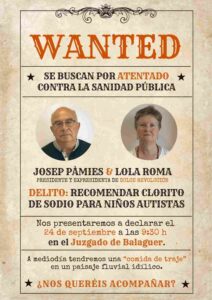
In March 2025, the Balaguer Courts (Lérida) admits three complaints for an alleged “crime against public health” against Lola Roma, Josep Pàmies and the Dulce Revolución Association, being summoned to testify in September 2025. The corresponding allegations for this process are initiated.
|
Monday
|
Tuesday
|
Wednesday
|
Thursdays
|
Friday
|
Saturday
|
sunday
|
|---|---|---|---|---|---|---|
|
0 events,
|
0 events,
|
0 events,
|
0 events,
|
0 events,
|
0 events,
|
|
|
0 events,
|
0 events,
|
0 events,
|
0 events,
|
0 events,
|
2 events, |
|
|
0 events,
|
0 events,
|
0 events,
|
0 events,
|
0 events,
|
0 events,
|
|
|
0 events,
|
0 events,
|
0 events,
|
0 events,
|
0 events,
|
0 events,
|
|
|
0 events,
|
0 events,
|
0 events,
|
0 events,
|
0 events,
|
0 events,
|









It's proven once again that politicians are sold out to pharmaceutical companies, regardless of their political affiliation. We suffer attacks on public health at their hands... They prohibit what's good, what's healthy... they permit and promote what's bad. Fortunately, fewer and fewer people are being fooled.
- Health information is truly limited, with easy access to biased and semi-misleading results containing half-truths.
- Disregard for public institutions in the system and lack of support for independent research.
- Difficulty accessing information on very promising but less lucrative results (I have very interesting reviews that don't exist in the usual medical environment due to misinformation)
- Doctors today have been displaced from an essential part of clinical medical practice (Galen was a doctor, not a pharmacist), this is Therapeutics. We can diagnose and treat with drugs manufactured by pharmaceutical companies, but the master formulas are quite complicated and expensive, due to the difficulty and complexity in the process of financing, authorization, etc.
consequently making it if not unviable, with enormous barriers
- Pharmaceutical laboratories are very necessary, I would say essential, but currently they have to change their policy and ethics, accepting that when they make a mistake in a line of research they have to consider the losses and not disguise it with misleading advertising with half-truths or export it to less developed countries, selling it as a panacea.
-Nowadays, drug agencies should renew their methodology and their consultants, as should the WHO... both are overly influenced by lobbies and consultants paid by very powerful pharmaceutical companies, with strategies that do not always coincide with the benefit of the population, especially when the results are not as expected or there is a risk of competition with the application of simple and accessible therapies.
-In healthcare, caution is especially necessary when applying the results of research to patients. The benefits and risks must always be weighed, and the decision must be left to the informed patient, their informed family, and the physician they select.
- Research is very restricted and it is very difficult to innovate with public funding through grants, since reviewers are generally handpicked and it is difficult for them to accept innovative research, especially on plants related to health. Even the scoring method is already aimed at hindering independence in research and overestimating the value of drugs and genetics.
The following three questions must be asked:
1. Why does the ICS, with the approval of the Catalan Health Service, the Regional Ministry of Health and the College of Physicians of Barcelona, forcibly retire expert specialists accredited as suitable by Occupational Health, even if they have results in clinical, research and teaching, at the age of 65? It is done selectively according to the management strategy (political position), endorsed by an arbitrary and dubious report from the boss, at the request of said management.
2. Why do they limit by age < 35 years to finance innovative research projects with social impact in the Generalitat de Catalunya instead of evaluating the project? (Calls for health research projects do not allow as principal investigator, the expert who develops the project if he is over 35 years old, with the excuse of promoting work for young people (it is not incompatible) and consequently certain managers propose people under 35 years old by hand, to present the project that has been carried out by the expert over 35 years old, in order to obtain funding???. Is it ethical????
3. Why is it considered ethical in clinical trials to give a placebo to patients with ALS, cancer, or any other serious illness?
Shouldn't certain aspects of ethics committees be changed?
PS*** there are still many barriers!!!!!